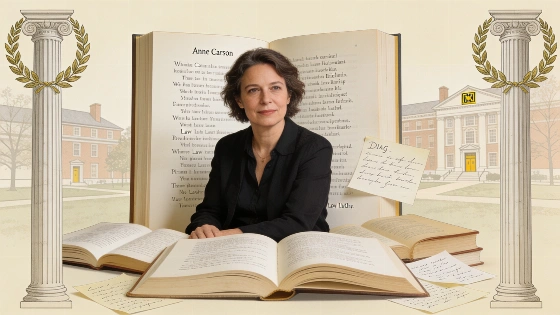
The Swedish Academy honored Canadian poet Anne Carson, who taught at the University of Michigan from 2003 to 2009. The prize recognizes a career built across writing, translation and university teaching.
The Swedish Academy announced the award on Oct. 8, giving the University of Michigan a direct connection to one of the world's most prestigious literary honors. Carson's writing has carried classical tradition into forms that resist easy classification.
The Canadian poet and writer is 76. She taught at the University of Michigan College of Literature, Sciences and the Arts from 2003 to 2009. The academy said her work created new forms of contemporary literature through an inventive engagement with the classical past, a description that fits the range of her poetry and translations. It also covers her essays and dramatic writing.
The Nobel Prize announcement noted that the news surprised Carson. Ingrid Carlberg, permanent secretary of the Swedish Academy, described Carson's work as joining a philologist's intense attention to words with a poet's search for new meaning.
A career across literary forms
Carson's work resists a single category. Her books move between verse and prose, often using dialogue or translation to change the shape of the page. Her projects have also extended into opera libretti and literary criticism. Verse novels form another part of that body of work.
Reuters has characterized Carson's literary career as a continuing movement among poetry, translation and university teaching. That range is central to her reputation, though the Nobel citation rests on more than a list of genres.
She is widely known for translating classical Greek literature and for using that tradition as working material rather than a fixed boundary. Her 1998 verse novel Autobiography of Red remains one of the clearest examples, bringing ancient influence into a modern literary structure.
The Nobel recognition rests on work that moves between academic study and creative writing. Carson has treated scholarship and translation as connected practices. Poetry then reshapes both.
Carson was born in Toronto and holds three degrees from the University of Toronto. She is the first graduate of that university to win the Nobel Prize in Literature and the second Canadian woman to receive the award, after Alice Munro. The university's account identifies Carson as the 19th woman among the 123 literature laureates.
The prize includes 12 million Swedish kronor. Carson is scheduled to receive the Nobel medal and diploma at the award ceremony in Stockholm on Dec. 10, 2026, according to the University of Toronto account.
Michigan remembers her teaching
At Michigan, Carson was part of the College of Literature, Sciences and the Arts for six years. University President Domenico Grasso said the institution was pleased for Carson and credited her with enlightening students as a faculty member and mentor.
LSA Dean Rosario Ceballo described Carson as a classicist, poet and translator whose work crosses traditional disciplines and genres. Ceballo said Carson's academic work would remain part of the college's legacy. Her time at Michigan, she added, left a lasting impression on the university community.
The university's account of Carson's tenure appeared in an Oct. 8 University Record article. The timing places her Michigan teaching in the immediate context of the Nobel announcement, while showing that the award recognizes work developed across a much longer career.
An unexpected call from Reykjavik
Carson learned of the award at her home in Reykjavik when the Nobel Prize organization called. In an interview with the organization, she described the news as almost unbelievable and said she never expected to receive the honor.
Her reaction contrasted with the scale of the announcement. The Nobel Prize in Literature is widely regarded as the most prestigious honor in literary arts. Carson's response reflected the surprise of an author whose work has followed an unusual path rather than a conventional commercial formula.
For readers in the Farmington area, the story is primarily a university and international arts milestone rather than a municipal or school-board action. The City of Farmington, the City of Farmington Hills and Oakland County administration have no stated role in the Nobel decision. Their relevance here is the regional audience that follows University of Michigan news and cultural developments.
Likewise, the Farmington Public Schools board and State of Michigan departmental registries are not the records that establish this award. The authoritative record is the Swedish Academy's announcement, with biographical and institutional context supplied by the University of Michigan and University of Toronto.
That distinction matters for local reporting. No city resolution, public hearing notice or school-board vote is needed to verify the honor. The Michigan connection is Carson's six-year faculty appointment and mentorship of students, not an action by a local government or K-12 district.
Carson's recognition has particular weight for Michigan's academic community. The university employed a writer who later received a major award and hosted a faculty member whose teaching and scholarship connected classical literature with experimental contemporary forms.
Carson's Nobel Prize places that connection on the world stage. Her work links translation and criticism with creative writing, while Michigan's specific role in that record comes through her six years of teaching and mentorship.