
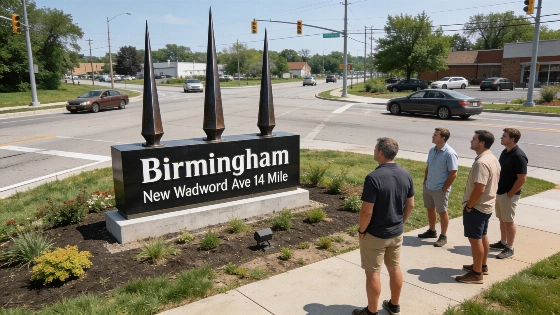
A new $700000 gateway sign in Birmingham has drawn criticism from residents who say its spiked design feels unwelcoming and hard to read while city officials have declined to comment on possible changes
Birmingham's latest attempt to mark its city limits with a bold new gateway sign has backfired for many residents, who say the installation's spiked design sends the wrong message about the upscale Oakland County suburb. The sign, recently erected at Woodward Avenue and 14 Mile, was intended to reflect the city's identity and celebrate its public art. Instead, it has become a lightning rod for criticism, with some locals comparing its sharp, upward features to swords or even the infamous Iron Throne from HBO's "Game of Thrones."
While the city's leadership has largely stayed silent, the reaction from the community has been anything but quiet. Social media posts from local businesses like Caruso Caruso have drawn dozens of comments questioning the sign's appearance and intent. Some residents, including experienced sign designer and former Birmingham resident Robert Dempster, have called the sign embarrassing and urged city officials to reconsider the design. Dempster, who now lives in Bloomfield Township, argued that a city's sign should inspire pride and reflect its character, not leave visitors with a sense of unease.
Design Origins and Public Response
The new sign is part of a broader $700,000 branding initiative launched by Birmingham in April. The design draws inspiration from "Freedom of the Human Spirit," a sculpture by Marshall Fredericks that stands in Shain Park. City officials and the advertising agency McCann Detroit hoped the sign would evoke the city's pedestrian-friendly downtown and its reputation for upscale shopping and dining. However, the translation from sculpture to street sign has not landed as intended for many observers. Instead of an uplifting symbol, the sign's three large spikes have been interpreted as aggressive or even menacing by some residents.
Comparisons to other controversial public art projects in metro Detroit have surfaced. Critics have likened Birmingham's sign to Sterling Heights' "The Halo," which became known as the "Golden Butthole" after its 2019 debut, and to Detroit's recent "DETROIT" sign, which was mocked online for its resemblance to a discount marketplace logo. Despite the backlash, Birmingham's sign has not yet reached the level of notoriety seen with those projects, but the city's muted response has left residents wondering if any changes will be made.
City Officials Remain Quiet
When asked about the criticism, Birmingham's Communications Director Marianne Gamboa stated that the city had no additional comments and pointed to information already distributed to the community. This lack of engagement has frustrated some residents who feel their concerns are being ignored. The sign's readability has also come under fire, with Dempster and others noting that its design makes it difficult for drivers and pedestrians to identify the city at a glance.
Other Oakland County communities have recently installed new gateway signs, including Oak Park and Farmington Hills, but Birmingham's stands out for the intensity of its public reaction. The city's branding effort was meant to reinforce its image as a "quaint" and "progressive" place to live, according to its official history. Instead, the sign has sparked debate about whether public art and branding projects are truly serving the community's interests or simply generating controversy.
Context and Next Steps
Gateway signs are a common tool for cities seeking to define their identity and welcome visitors. In Birmingham's case, the project was developed by a local committee and a professional advertising agency, with the intention of connecting the city's public art to its broader image. The city, incorporated in 1933 and home to about 22,000 residents, has long promoted its walkable downtown and small-town charm. While some residents hope for a redesign, city officials have not indicated any plans to revisit the project.
Public art and branding efforts often generate strong opinions, as seen in other Michigan communities. For example, a reported earlier event in Farmington Hills highlighted how community spaces and public projects can become focal points for local identity. In Birmingham, the debate over the new sign underscores the challenge of balancing artistic vision with public acceptance, especially when taxpayer dollars are involved.
As it stands, Birmingham's gateway sign remains in place, a physical marker of the city's ambitions-and its current disconnect with some of its residents. The city's reluctance to address the criticism directly suggests a missed opportunity to engage with the community and adapt public projects to better reflect local values. Until officials take a more active role in the conversation, the sign will likely continue to symbolize not just Birmingham's boundaries, but also the gap between city hall and the people it serves.