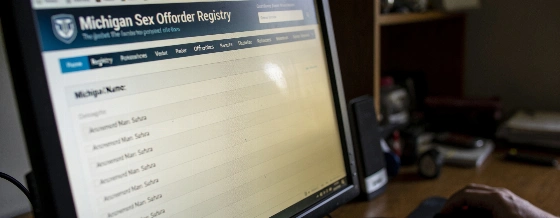
Nearly 20,000 names have been wiped from Michigan's public sex offender registry after a Supreme Court ruling limited listings to crimes after July 1, 2011. The public list is now almost half its former size.
Michigan's public sex offender registry has shrunk by almost half. On September 9, 2026, the Michigan Supreme Court ruled that more than 20,000 names had to be removed. The decision covers anyone whose offense happened before July 1, 2011. In Farmington and across Oakland County, people and officials are now asking why so many records have vanished from the state's searchable database. Cities like Farmington depend on the registry for public safety alerts and community notifications.
The Michigan State Police say the number of registered offenders dropped from about 43,000 to 23,000 after the court's order. Now, only people convicted of qualifying crimes after July 1, 2011, are listed for the public to see. Everyone else has been taken off the online registry. Their information is no longer available through the usual state website. Colonel James Grady II, director of the Michigan State Police, said the department followed the court's order, which was based on the constitutional ban on retroactive punishment. Details are available from the Michigan State Police.
Supreme Court decision and immediate impact
The Michigan Supreme Court found that the tougher rules in the Sex Offender Registration Act (SORA), changed in 2011 and 2021, cannot be applied to people whose crimes happened before July 1, 2011. The court said using these rules for older cases would be an illegal ex post facto punishment, which both state and federal law forbid. Because of this, nearly 20,000 people who were on the registry are now gone from the public database. This change affects local police and the Farmington Public Schools board, which often checks the registry for campus safety planning.
Even though these names are off the registry, the criminal convictions themselves are still public record. But now, anyone who wants to see those records has to file a formal request with local court clerks, like those at the Oakland County Clerk's Office. It's no longer a quick online search. This makes it harder for residents to check on their neighborhoods or for people involved in public hearings and safety planning.
Community concerns and official response
The sudden drop in the registry's size has worried residents who use it to keep track of offenders living nearby. Some say the registry's purpose is weakened if old information is no longer easy to find, especially for people trying to make decisions about where they live or who they interact with. The City of Farmington Hills has seen more questions from residents about how to get older records and what these changes mean for local safety rules. More details are posted by the Farmington Hills City Council.
Police have made it clear that this change comes straight from the Supreme Court's reading of state law. It is not a policy choice. The Michigan State Police now keep a public registry that only lists post-2011 convictions, as the court ordered. Local agencies, including the Farmington Department of Public Safety, are still watching and responding to community concerns. They stress that the legal change does not affect the supervision or reporting rules for people still on the registry.
How the registry works now
Anyone looking for information about sex offenders in Michigan will now only see people with convictions after July 1, 2011. To find records for crimes before that date, you have to go through the court system. This takes more time and effort. The state has not set up any new website or database for the removed information. The Farmington Public Schools board has changed its own safety protocols to match the new limits on public data.
The Michigan Sex Offender Registry was meant to give residents a simple way to check for offenders in their area. Now, its reach is much smaller. This raises questions about how to balance legal rights with public access to information. The Farmington Voice will keep following updates from the State of Michigan and local agencies as the community adjusts to these changes.
The Supreme Court's decision has changed how Michigan handles and shares information about sex offenders. The ruling is based on legal interpretation, but the result is a registry that now covers fewer than 60 percent of the people it once did. Residents who used the database for safety checks now face a more complicated process to get older records. This change shows the ongoing struggle between legal rules and the public's need for transparency about community safety.