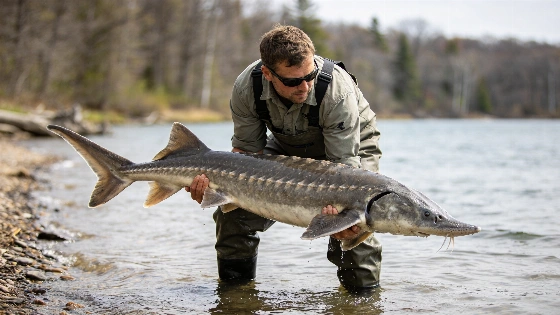
A new study using decades of Great Lakes data suggests some Michigan lake sturgeon could be centuries old, challenging previous estimates and raising new questions for fisheries management and conservation.
Some lake sturgeon currently swimming in Michigan's Great Lakes may have been alive since before the United States was founded, according to new research that dramatically revises what scientists know about the species' lifespan. The study, published in the "Journal of Fish Biology," analyzed 44 years of data from five Great Lakes sturgeon populations and found that some individuals could live between 200 and 400 years-far longer than previously believed.
Researchers used long-term tagging and recapture records to track how slowly individual sturgeon grow over decades. Instead of relying on traditional methods that count growth rings in fin spines a technique that becomes less reliable as fish age—the team estimated how long it would take sturgeon to reach the largest sizes observed in each population. Their findings suggest that a 160-centimeter male sturgeon could be between 90 and 279 years old, while a 180-centimeter female could range from 99 to 427 years, depending on the river system.
Decades of Data Reveal Slower Growth
Before this study, the oldest documented lake sturgeon was 152 years old, and most experts believed the species typically lived 70 to 100 years. The new approach, based on decades of conservation and monitoring work, revealed that some sturgeon grow extremely slowly after reaching maturity. In one case, a male sturgeon in Michigan's Sturgeon River grew just 2.7 inches over 34 years, highlighting a growth rate of less than a tenth of an inch per year.
Growth rates and estimated lifespans varied significantly between river systems. Sturgeon in the St. Clair River, for example, grow faster than those in the Black River, likely due to differences in water temperature and food availability. The Black River's colder, less productive environment appears to support slower growth and potentially longer-lived fish.
While the study's longevity estimates are not exact ages, the researchers caution that uncertainty increases for the largest and oldest fish, especially when models extend beyond the sizes of fish directly measured. The oldest estimate came from a male in the Black River, which could be anywhere from 318 to 737 years old, though the true age is uncertain.
Findings Could Change Sturgeon Management
The findings have important implications for fisheries management and conservation. Lake sturgeon populations in Michigan were severely depleted by overharvest and habitat loss in the late 1800s and early 1900s. Today, harvest is tightly regulated, with quotas such as the annual limit of six fish from Black Lake's estimated adult population of about 1,200. The study suggests that even as populations recover, managers will need to account for the species' slow growth and late maturity when considering future harvest opportunities.
The research method, adapted from studies of Greenland sharks, could also be applied to other long-lived fish species such as lake trout. However, independent validation—such as radiocarbon dating used for sharks-will be needed to confirm the extreme ages suggested by the models for lake sturgeon.
Long-Term Monitoring Made the Study Possible
Decades of tagging and monitoring, originally intended for conservation and rehabilitation, made this research possible. The study highlights the value of long-term data collection in understanding the biology and management needs of long-lived species in Michigan's waterways.
Lake sturgeon are among North America's largest and longest-lived freshwater fish. Their continued recovery in Michigan depends on careful management, habitat protection, and ongoing research to ensure that these ancient fish remain part of the Great Lakes ecosystem for generations to come.