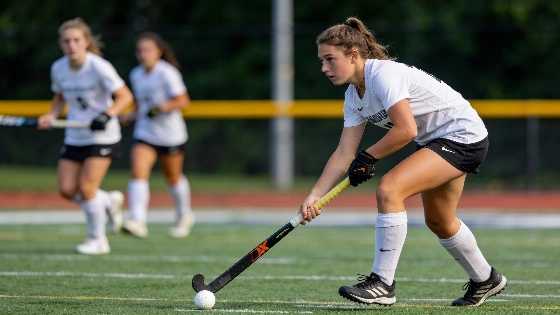
Farmington Hills Mercy raised its win total from four games in 2024 to 10 last season. The team entered the final stretch at 6-6 with two regular-season games left.
Two regular-season games remained when Farmington Hills Mercy reached the final stretch at 6-6. The team had won four games in 2024 and 10 last season.
The school is part of the wider community served by the City of Farmington Hills and Oakland County administration. Mercy's field hockey team is a private-school program, not a Farmington Public Schools team. That difference matters when readers compare local schedules, school records and athletic opportunities.
Available Michigan High School Athletic Association records place Mercy within the state's high-school sports system. They do not provide a separate public statistical profile for the field hockey program during this period. An MHSAA update dated Oct. 2, 2026, mentioned Farmington Hills Mercy in connection with swimming and diving, not a confirmed field hockey result.
The verified account stops there. Mercy's record was 6-6 with two games remaining during the reported season. Later results have not been confirmed.
Many Mercy players arrive without the technical background offered by established youth programs. The school is building varsity results and the lower-level structure needed to give future players more time with a stick and ball.
Learning the sport
Mike Wilson took over the Farmington Hills Mercy program three years ago after coaching soccer. He made the switch so he could continue coaching his daughter. The job soon became a longer project.
His daughter has graduated. Wilson stayed because of his commitment to coaching and his interest in building the program.
Mercy does not have a traditional youth feeder system. Wilson said the program relies on a learn-to-play program instead. Many ninth graders arrive without ever handling a field hockey stick or ball.
That gap slows development at every level. Players must learn positioning and ball control before they can handle the technical demands of varsity competition.
The school now has freshman and junior varsity teams alongside varsity. Mercy does not make cuts for the freshman team. Most players there are still learning the sport.
Wilson uses that group to build skills and team cohesion. It gives new athletes a place to start.
That matters.
A tougher varsity test
Mercy's schedule has included strong competition in the Catholic High School League and difficult nonleague matchups. Saline has been one test. Grosse Pointe South was scheduled for the regular-season finale.
Those games give a developing team a demanding measure of its skills before the state tournament.
The record does not point to a dominant team. It does show a program that has added wins and continued to challenge itself.
No independently verifiable record was found for the team's eventual finish, later matches or state-tournament appearance after the reported portion of the season.
Wilson starts with athletic ability. Fewer players arrive after years of technical training, so he looks for athletes who can cover mistakes through speed, movement and work rate.
They keep learning the finer points of the sport. That approach has helped Mercy stay competitive as its players gain experience.
Players setting the pace
Senior Addison Kuebler leads Mercy in scoring this season. She also stood out during her junior campaign in 2025.
Kuebler plays at midfield and forward. She gives the team an attacking option and can work through the middle of the field.
Junior Mia Retzbach has made her mark by controlling possession. Wilson also points to the less visible work she does in midfield.
Retzbach runs, organizes play and helps Mercy keep the ball. That work can shape a game without producing a goal.
Junior Corrina Rebain has been another important contributor, especially on defense. Wilson said he could name every player on the roster.
The team depends on shared improvement. Not one standout.
Building below varsity
Mercy's next stage depends partly on creating more chances for players before they reach high school. A middle school program is getting started.
That could introduce athletes to the sport earlier. It could also strengthen the connection between the school's lower levels and varsity team.
The pipeline would address the problem Wilson described. Ninth graders often arrive without prior experience.
More middle school participation would give players time to learn the rules, stick skills and team concepts before competing for varsity playing time.
Families looking for broader local athletic information can use the City of Farmington Hills portal for municipal services and community information. It is not a substitute for school athletic records.
Mercy's sports eligibility and postseason information fall under the MHSAA framework. Its public materials confirm the school's athletic status. They do not establish later field hockey results that have not been documented elsewhere.
Mercy was expected to try to make an impact in the state playoffs as the second MHSAA-sanctioned season of field hockey came to an end. The immediate result would matter.
The clearer measure is the structure beneath the varsity team: freshman and junior varsity squads, a no-cut entry point for beginners and a middle school program designed to bring in players earlier.
Farmington Hills Mercy is taking the long route. Its record rose from four wins to 10 and then to 6-6 with two regular-season games left.
Many of its players are still learning a sport they had never played before high school. Wilson's patient approach fits the program.
The wins show progress. The feeder system will decide how long it lasts.